How to Turn Domain Expertise Into a Software Product
Turn domain expertise into software with a decision inventory, exception tests and a worksheet for the first task users can finish without you.
Luka Abramovic3 min read
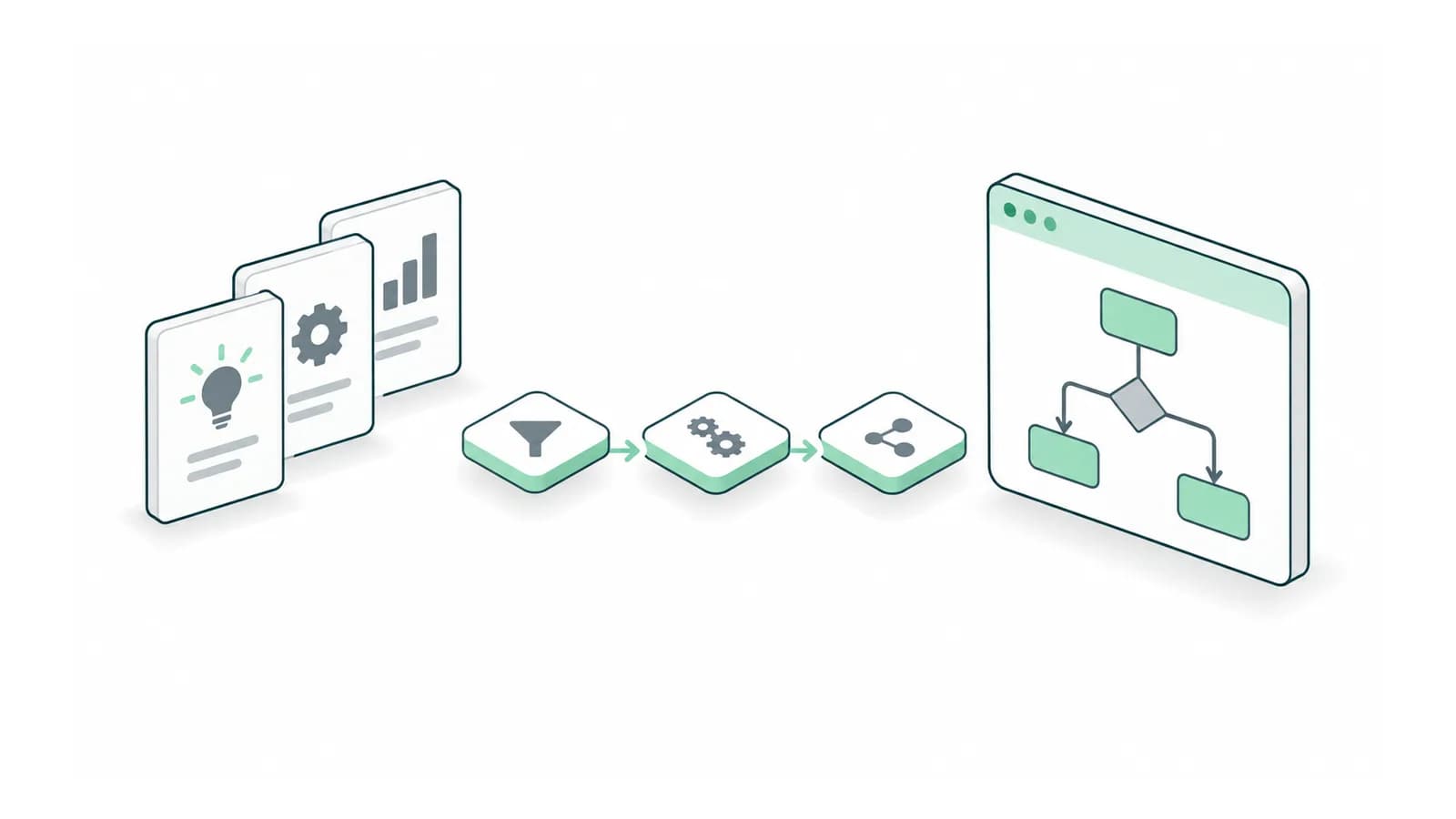
To turn domain expertise into software, start with a decision someone else needs to make repeatedly. Collect the inputs you inspect, the question you ask next and the condition that makes you stop. A library of advice is useful reference material. A product also needs to know which piece applies to the situation in front of it.
For a consultant, trainer or specialist founder, the first useful unit can be small. It might produce a usable project brief, identify missing evidence or help a customer choose the next task. Choose an outcome the user can recognize without needing you to explain why it matters.
Extract the decisions from three completed tasks
Open three examples of work you are permitted to reuse. Pick one straightforward case, one incomplete case and one exception. Reconstruct what you knew at each decision, including facts that arrived later. Do not give the product information the real user would not yet have.
Write the initial request, the evidence you checked, the first question you asked and the resulting action. Then ask what would have changed your answer. If changing one input changes the recommendation, that input belongs in your decision inventory.
An illustrative example is a specialist helping customers prepare equipment maintenance requests. A missing serial number calls for clarification. Conflicting equipment identities call for resolving the conflict. Treating both as an empty form field loses a meaningful distinction.
Copy this decision inventory into a worksheet
| Decision | Evidence available now | Next step | Stop condition |
|---|---|---|---|
| Can this request be assessed? | Equipment identity and symptom | Ask for the missing identifier | Two records identify different equipment |
| Is more evidence needed? | Symptom and last service record | Request the specific missing record | The customer cannot obtain it |
| Is the brief ready to send? | Required fields and attachments | Present the draft for review | Unresolved conflict remains |
Replace these rows with your decisions. Add one example that should pass and one that should fail to each row. A rule without a counterexample can look precise while meaning something different to the founder and developer.
Test a boundary before designing more screens
Give a colleague two almost identical requests. Change only the field you believe controls the next action. Ask them to use the worksheet without asking you for help. If both requests receive the same answer when you expected different answers, the rule or its evidence is missing.
Record interventions separately from outcomes. In an illustrative trial, eight users finish a brief, but five need the founder to interpret a question. Task completion is eight of eight. Independent completion is three of eight. Calling the first number proof of self-service would hide the work the software has not captured.
Choose the first independent outcome
A practical starting rule is to build the smallest journey that produces one usable output and has a clear route for exceptions. This is a design judgment, not a promise about development time. Keep the expert available for cases outside the boundary while the product handles the defined task.
Circle the decisions a user can complete from evidence they already possess. Mark the others as clarification or expert review. Hand the developer this inventory, the paired test cases and the definition of a usable output. Those artifacts describe what the product must preserve when it turns your knowledge into an interface.
Bring one completed customer task and one awkward exception. We can map the first independent outcome and the rules it needs. Discuss the first release with Adamant Code.