Grounded answers
Support answers use approved knowledge resources.
Updated
Chat once depended on two people noticing each message, with immediate pickup estimated at just 5%. The connected system now delivers a typical 36-second website-chat response and keeps personalised follow-up moving after assessment.
A 58-second walkthrough of website service questions, assessment booking links, human handover and guidance inside ErgoWOW.
58 sec
typical first response on website chat
conversations across seven support inboxes over five months
conversations per month over the five-month period
Rounded from 11,782 conversations over five months.
messages exchanged over five months, roughly 3,000 per month
The monthly figure is a rounded five-month average.
personalised check-ins across 1,749 employee profiles
This was not simply a faster reply. It was a shift from support constrained by staff availability to a connected operation that could stay responsive and continue contact after an assessment.
Chat was available to just two clients and depended on two people noticing each message. Immediate pickup was estimated at roughly 5%. When a chat was missed, users were generally redirected to email with a one-business-day response expectation.
Five months later, website chat had a typical first response of 36 seconds. The connected operation was averaging approximately 2,350 conversations and roughly 3,000 messages per month across seven inboxes, while ErgoWOW had sent 3,019 personalised check-ins across 1,749 employee profiles.
Fast answers mattered, but the system also had to recognize when a conversation needed context, sensitivity, or human judgment. Treating every message as a chatbot question would have created more risk than value.
Website chat, internal app chat, and email inboxes needed one consistent operating model.
Pricing, bugs, unhappy users, unknown answers, sales opportunities, and explicit human requests required handover.
Knowledge, parameters, and follow-up behavior had to remain scoped to the right client context.
We worked across support workflow design, AI behavior, Chatwoot deployment, Outlook integration, self-assessment UX, and follow-up logic. The central product decision was to automate routine movement through the system without hiding the point where a person should take over.
We mapped separate channels and follow-up processes into one connected customer operations flow.
We established the cases that should move from AI triage to a team member instead of forcing an answer.
We integrated the channels, knowledge sources, assessment experience, and scheduled follow-up needed to make the workflow usable.
The system treats each conversation as an operational decision, not only a request for generated text.
A message enters through website chat, internal app chat, or an email inbox.
The AI uses approved resources, manuals, website content, and relevant order information.
The workflow identifies sensitive, uncertain, commercial, or explicitly human cases.
Routine work continues automatically while the right exceptions move to a team member.
Ergo Global needed more than a chatbot. We connected support channels, knowledge, self-assessment, follow-up, and human handover into one customer operations system.
Support answers use approved knowledge resources.
Pricing, bugs, unhappy users, sales opportunities, and edge cases are escalated.
Assessment check-ins trigger short questions, tailored tips, and escalation when needed.
The AI sits inside a broader operations system that supports assessment, follow-up, routing, and consistent service across channels.
Chatwoot brings customer conversations into a shared interface for AI and human handling.
Free-text input and clarifying questions replace a rigid assessment experience while preserving scoring and escalation logic.
Short check-ins, relevant guidance, and problem escalation keep the workflow moving after an assessment.
Client-specific information and parameters remain separated inside the operating model.
Over five months, the support platform managed 11,782 conversations across seven support inboxes and exchanged 15,120 messages. Website chat achieved a typical first response of 36 seconds. ErgoWOW also sent 3,019 personalised check-ins across 1,749 employee profiles. The automated follow-up programme delivered the equivalent of approximately 150–250 hours of manual outreach over five months. The estimate assumes three to five minutes of manual work per check-in. This is a modelled comparison, not a measurement of time saved.
Customer operations AI becomes useful when it can move routine work forward, stay grounded in approved information, and make human handover part of the product rather than an exception added later.
We can help turn fragmented support channels into a grounded workflow with clear routing, follow-up, and human handover.
Bring one manual process, disconnected workflow or software problem. We’ll discuss what needs to work differently, the constraints involved and a sensible next step.
Talk through your workflow
We translated a founder's market vision into 50+ screens, 15+ workflows, and a structured invention process for inventors, service providers, investors, and admins.
GTS Innovative had a clear market vision and rough wireframes, but the user journeys, permissions, product logic, and AI workflow still needed definition. We turned that starting point into a complete marketplace platform.
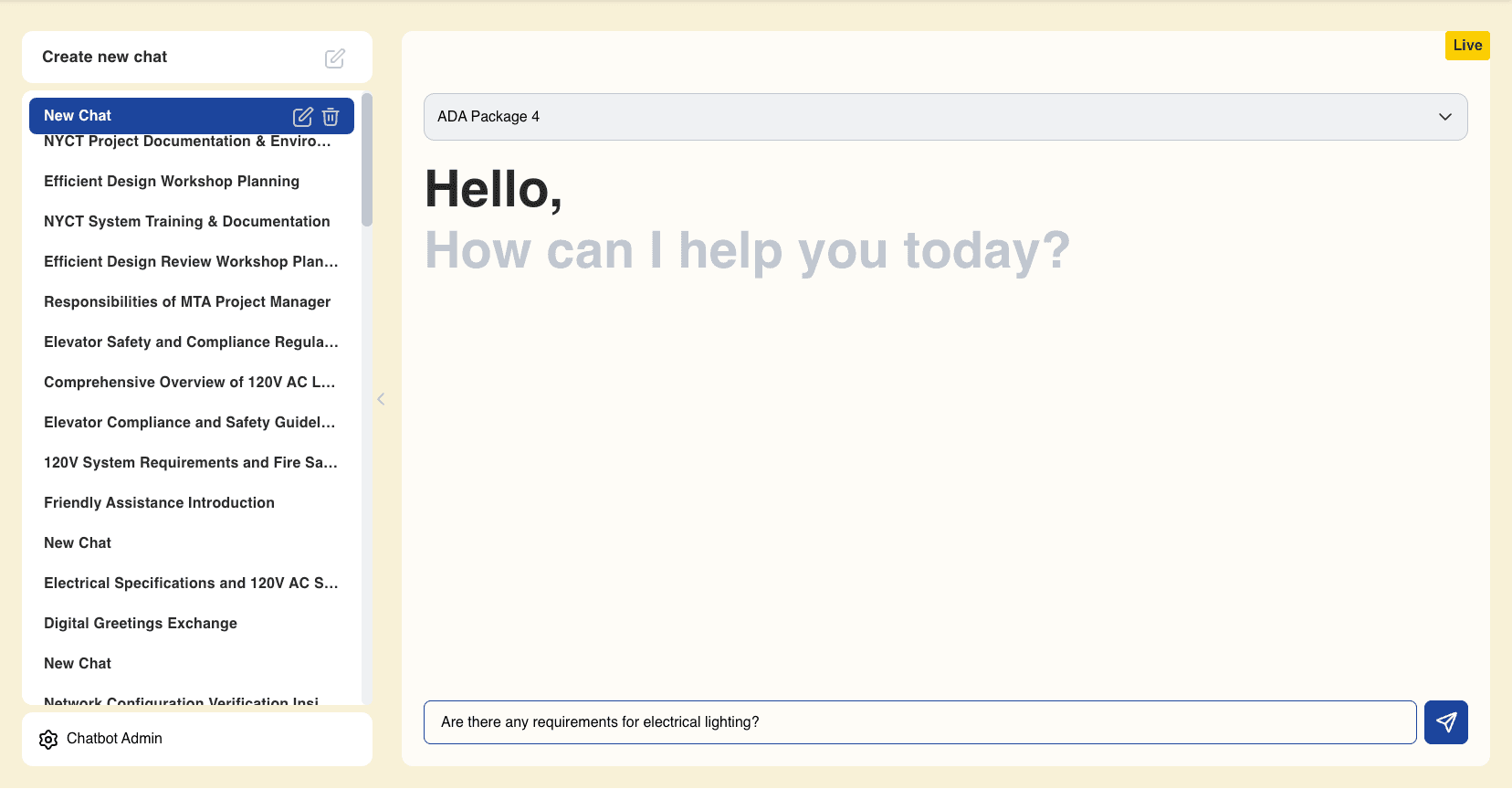
Source-cited AI search across bid-document packages spanning up to 50,000 pages.
TCE engineers were navigating bid-document packages that could reach 50,000 pages using Command-F, local files, printouts, and highlighters. We built a source-cited AI search system that brings the answer, page, paragraph, and supporting evidence into one workflow.
Explore document intelligence, support triage, and internal data workflows, with people in control.
A practical framework for choosing the next improvement when your business outgrows its tools.