Guided Workflow or Chatbot for a Product Built From Expertise?
Choose a guided workflow vs chatbot by testing required inputs, branching questions, revision and the final output your users need.
Luka Abramovic3 min read
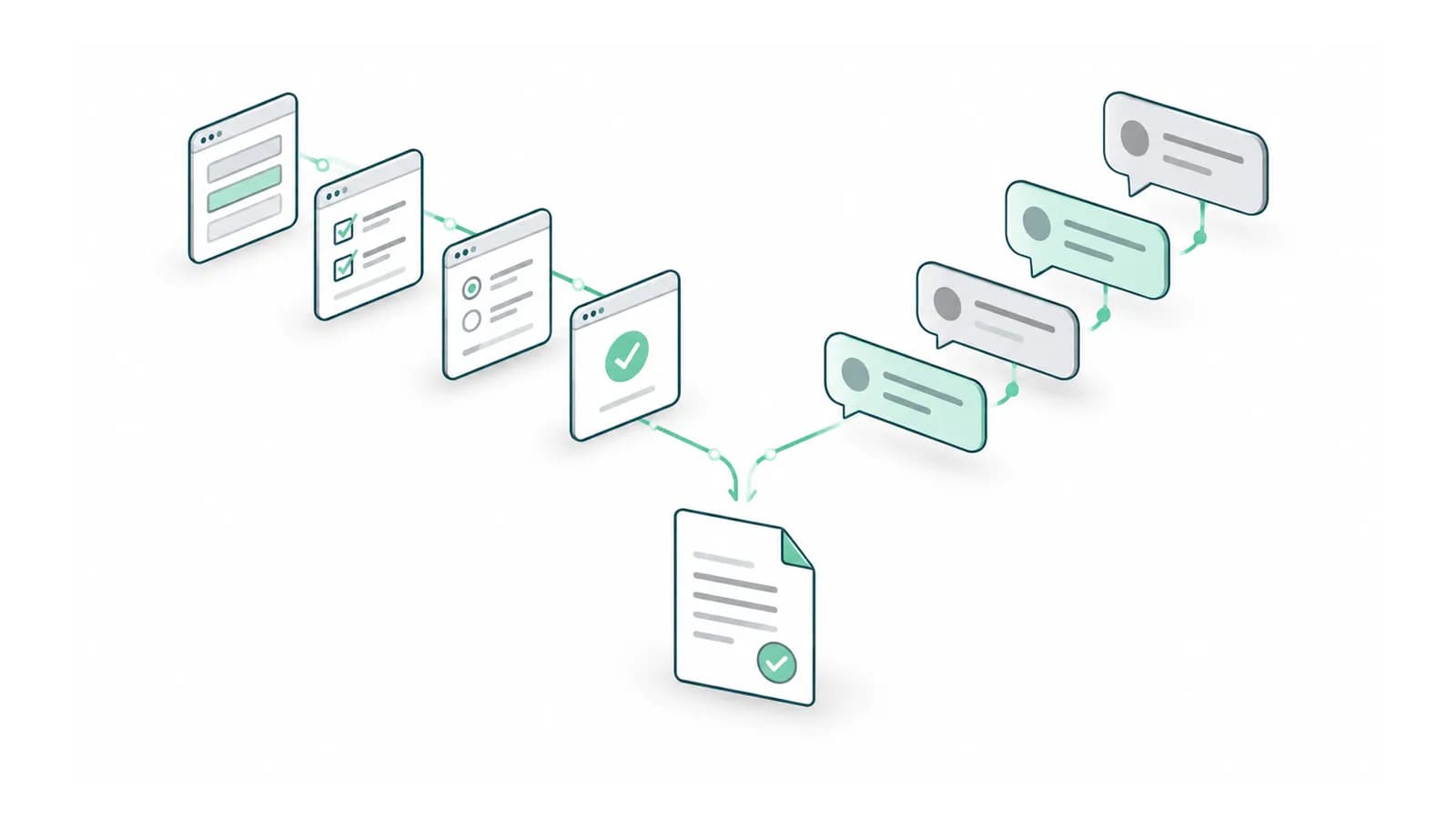
The guided workflow vs chatbot choice turns on what the product must know before it can produce a usable result. When required inputs are stable, visible fields can make omissions clear. When users need help describing a situation, conversation can help collect those inputs. Both routes still need an explicit definition of completion.
For a domain expert, the useful question is where the user needs interpretation. Do not make someone compose a perfect prompt for a task whose required information you already know. Equally, do not force an unusual situation into a field that cannot express it.
Sort the information by how it can be collected
| Information | Starting interaction | Check before completion |
|---|---|---|
| Known category or date | Structured selection | Valid and confirmed value |
| Unclear problem description | Conversation or guided questions | User confirms interpretation |
| Required attachment | Visible upload step | Stored and associated with the task |
| Final recommendation | Reviewable output | Inputs and next action are visible |
Use the table to sketch a hybrid before deciding that the entire product must be chat or forms. A short conversation can clarify a problem while a structured summary records what the product believes the user meant.
Keep the confirmed task state visible
List confirmed inputs separately from the conversation. If a user says a date has changed, update the task’s date and identify any dependent result that needs review. Leaving both dates in a transcript without a canonical value makes later behaviour ambiguous.
Before generating an output, show the required inputs and any unresolved item. Let the user correct the summary directly. This gives the product a clear transition from collecting information to producing a result, rather than treating every message as an implicit instruction to continue.
Test the same task through both designs
Give participants equivalent fictional tasks and alternate which design they try first. Record the time to a usable output, missing inputs, corrections and help required. The point is to find why a design fails, not to claim a statistically reliable winner from a tiny pilot.
In an illustrative comparison, a chat route takes six minutes and needs two corrections. A guided route takes four minutes but cannot represent one unusual requirement. The guided route is faster for that task, while the exception reveals a missing escape path. A simple average would conceal the decision you need to make.
Write an interaction contract for the chosen route
Task the interaction supports
Required confirmed inputs
Questions used when an input is unclear
Where confirmed values are displayed
How a user corrects a previous value
When generation may begin
What marks the output as ready for review
How unsupported cases leave the automated path
Walk through a returning user who changes one answer and a first-time user who cannot answer a question. Check that each can see what remains unresolved without reading the whole conversation. Keep the final output available as a usable artifact rather than burying it between chat messages.
Choose the interface that makes the task’s decisions clear. The resulting contract can support forms, conversation or both without changing the expert standard underneath.
Bring the required inputs and one ambiguous customer request. We can map where structured guidance and conversation each help. Discuss the first release with Adamant Code.